Whether you are a professional DJ spinning at a Kolkata wedding, a sound engineer managing a live stage at a college fest, an anchor hosting a corporate event in Salt Lake, or a priest reciting mantras at a Durga Puja pandal — the microphone you use is the first link in your audio chain. Everything that follows — the mixer, the amplifier, the speakers — can only deliver what the microphone captures. Choose poorly, and no amount of downstream processing can fix it.
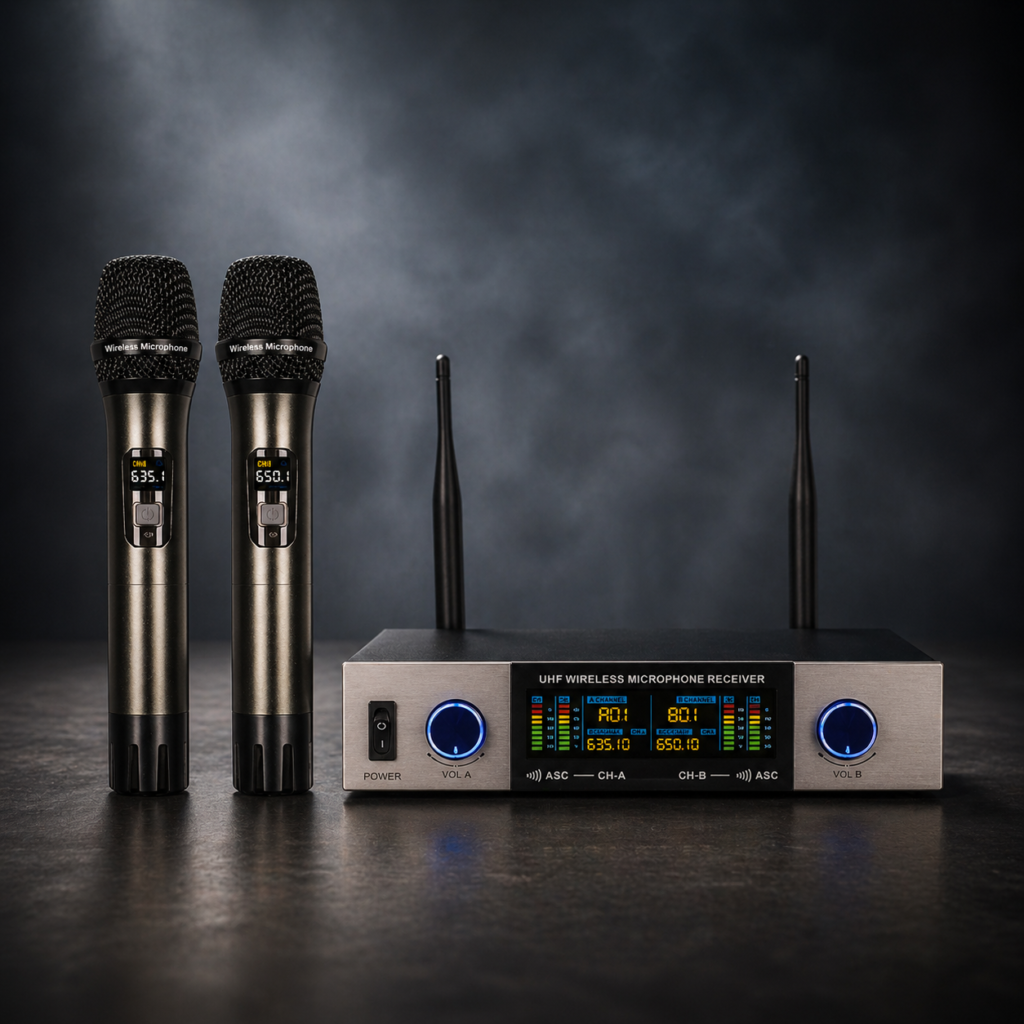
The biggest decision most professionals face is whether to use a wired dynamic microphone or a UHF wireless microphone system. Both have distinct advantages and trade-offs, and the right choice depends on your specific application, venue, and budget. This comprehensive guide covers everything you need to know about professional microphones for live sound in India — including a full comparison of wired vs wireless, key technical specifications, and how to choose the right microphone for your use case.
Understanding Microphone Types: Dynamic vs Condenser
Dynamic Microphones
Dynamic microphones are the workhorse of live sound worldwide — and the most widely used microphone type for stage, DJ, and event applications in India. They work on a simple electromagnetic principle: sound waves move a diaphragm attached to a coil inside a magnetic field, generating an electrical signal. Dynamic microphones have several key advantages for live use:
- High durability — the moving coil design is robust and can withstand drops, humidity, and rough handling common at Indian events
- No phantom power required — dynamic mics work without battery or 48V phantom power, simplifying setup
- Naturally high gain before feedback — the cardioid polar pattern of most dynamic mics effectively rejects off-axis sound, reducing feedback risk in loud stage environments
- Handles high SPL without distortion — dynamic mics can be placed close to loud sources like kick drums and guitar amps without distorting
Condenser Microphones
Condenser microphones use a capacitor-based design and require power (phantom power or battery). They are more sensitive, with a wider frequency response and more detailed sound reproduction. While condensers are ideal for studio recording and broadcast applications, their higher sensitivity also makes them more susceptible to feedback and handling noise in live event environments. For most DJ and live sound applications in West Bengal, dynamic microphones are the preferred choice.
Wired Dynamic Microphones — The Professional Standard for Live Sound
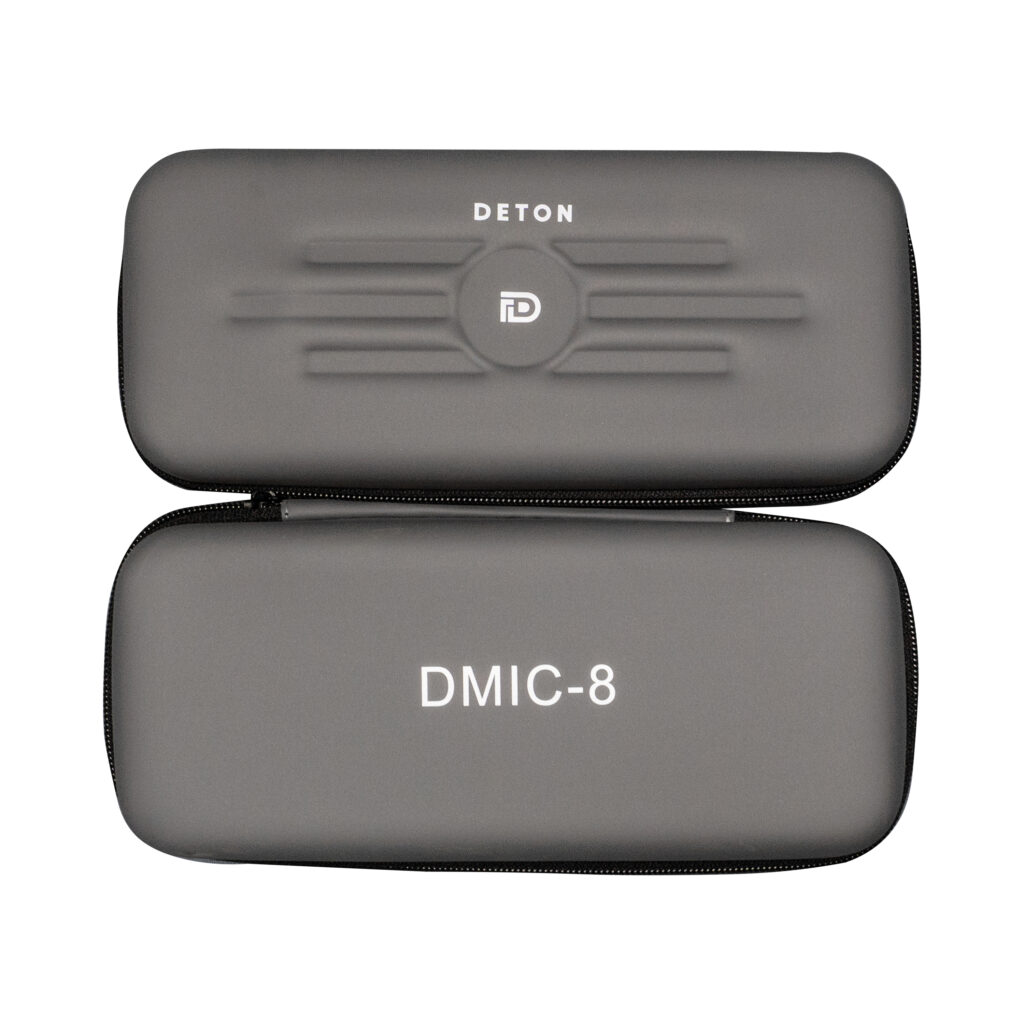
The Deton DMIC 8 is a professional wired dynamic microphone designed for live vocal performance, stage use, and public address applications. For DJs, MCs, comperes, and performers who work from a fixed position — behind a DJ desk, at a podium, or on a stage — a wired dynamic microphone provides the most reliable and highest-quality signal path.
Advantages of Wired Microphones
- Zero latency — the signal travels directly from the microphone capsule through the cable to the mixer with no processing delay
- No battery management — wired mics never run out of power mid-performance
- No frequency conflicts — wired mics do not compete for wireless spectrum, critical at large events in Kolkata where multiple wireless devices operate simultaneously
- Consistent signal — cable connections are interference-free and not affected by physical obstructions, competing signals, or distance
- Lower total cost — a quality wired microphone costs significantly less than an equivalent quality wireless system
- Longer lifespan — fewer components means fewer potential failure points over the lifetime of the microphone
When Wired Microphones Are the Right Choice
- DJ performances where the DJ is stationary at the booth
- Fixed podium or anchor positions at corporate events and conferences
- Backup microphone for any professional live sound setup
- Budget-conscious setups where wireless system cost is not justified by the application
- Environments with heavy wireless congestion — nightclubs, large events with many wireless devices
The Deton DMIC 8 wired dynamic microphone delivers professional-grade vocal clarity, durability, and reliable signal output for stage and event use across India.
UHF Wireless Microphone Systems — Freedom of Movement on Stage
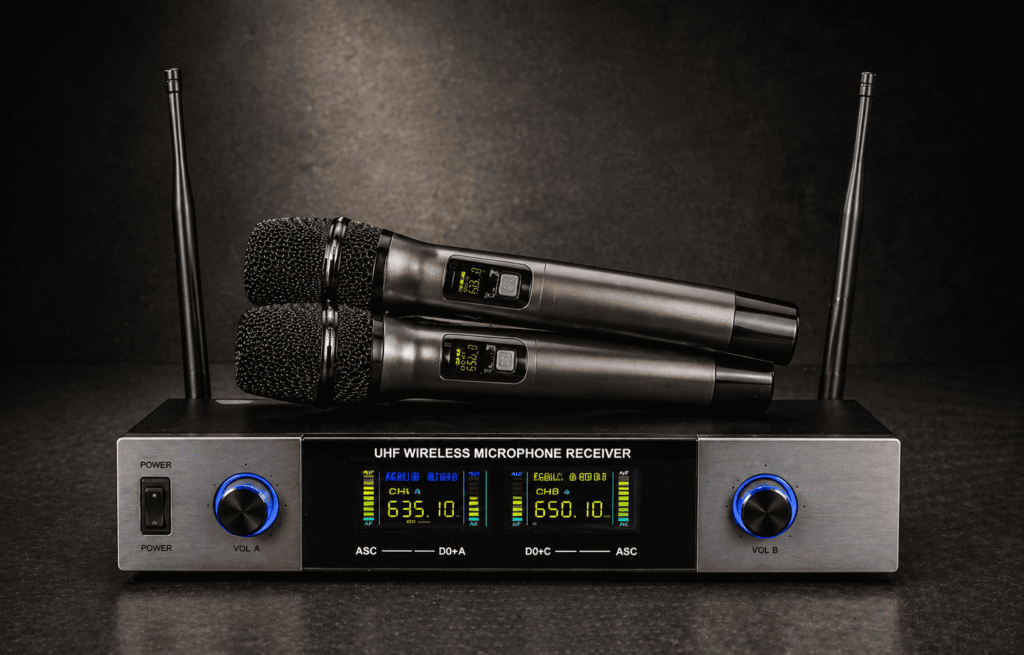
The Deton DWM 231 is a professional UHF (Ultra High Frequency) wireless microphone system designed for live events, stage performances, and public address applications where the performer or speaker needs freedom of movement. Wireless microphone technology has advanced dramatically, and modern UHF systems like the DWM 231 provide stable, interference-resistant signal transmission that rivals wired microphones in audio quality.
How UHF Wireless Systems Work
A UHF wireless microphone system consists of two components: a transmitter (the handheld microphone or body-pack with clip-on mic) and a receiver (connected to the mixer input). The transmitter converts the audio signal into a radio frequency signal and broadcasts it to the receiver, which converts it back to an audio signal and feeds it to the mixer. UHF systems operate in the 470–960 MHz frequency range, which provides better range, signal stability, and interference rejection compared to older VHF systems.
Advantages of UHF Wireless Microphones
- Complete freedom of movement — performers can move anywhere on stage or in the venue without cable restrictions
- Clean stage presentation — no visible cables improve the professional appearance of the performance area
- Multiple user capability — UHF systems support multiple simultaneous channels without interference when properly frequency-coordinated
- Ideal for Durga Puja rituals — priests performing pushpanjali and aarti need freedom of movement that only wireless can provide
- Audience interaction — comperes and event hosts can move through the crowd for interactive events
When UHF Wireless Microphones Are the Right Choice
- Stage performances where singers, dancers, or actors need to move freely
- Wedding anchors and event comperes who work across the venue
- Durga Puja, religious ceremonies, and cultural events with moving performers
- Corporate presentations where the speaker moves between slides and the audience
- DJ performances with a live MC component
Key Microphone Specifications You Must Understand
-
Polar Pattern — Cardioid vs Omnidirectional
The polar pattern describes which directions the microphone picks up sound. Cardioid (heart-shaped) microphones are the most common choice for live sound because they pick up sound primarily from the front while rejecting sound from the sides and rear. This directional rejection reduces feedback from monitors and PA speakers and minimises pickup of crowd noise and ambient sound. For stage, DJ, and event use in India, cardioid dynamic microphones are the standard choice.
Omnidirectional microphones pick up sound equally from all directions — useful for conference settings and ambient recording but impractical for live stage use due to extreme feedback susceptibility. Hypercardioid and supercardioid patterns offer even tighter front-facing rejection, useful for very loud stage environments.
-
Frequency Response
Frequency response describes the range of audio frequencies the microphone can capture and how evenly it reproduces them. Human voice typically occupies the 80 Hz to 8 kHz range. A microphone with a frequency response of 50 Hz to 16 kHz captures the full range of human voice with extension into the sub-bass and high-frequency harmonics that add presence and clarity to vocal performances.
Professional dynamic microphones often feature a slight presence peak (boost) in the 2–10 kHz region, which adds clarity and definition to live vocals — helping them cut through a mix of instruments and ambient noise at events in West Bengal.
-
Impedance
Microphone impedance determines how the microphone interfaces with the mixer input. Professional microphones use low impedance (typically 150–600 ohms), which allows long cable runs of 30 metres or more without signal loss or high-frequency degradation. This is critical for large event stages and outdoor festivals in West Bengal where the mixing position may be far from the stage.
-
Sensitivity
Sensitivity measures how efficiently the microphone converts acoustic sound into an electrical signal. Lower sensitivity ratings (more negative dB values, e.g. -55 dBV/Pa) are typical of dynamic microphones — they require more gain from the mixer preamp but are less susceptible to feedback and handling noise. Higher sensitivity (e.g. -35 dBV/Pa) is typical of condenser microphones — more detail but more feedback-prone in live settings.
-
Build Quality and Metal Body Construction
For professional live use in India — where microphones are used at hundreds of events per year, transported in vehicles, and handled by multiple people — build quality matters enormously. Microphones with metal body construction withstand drops, rough handling, and the humidity conditions of outdoor events far better than plastic-bodied microphones. The Deton DMIC 8’s robust metal construction is specifically designed for the demands of professional Indian live sound use.
Wired vs Wireless — Side by Side Comparison
| Factor | Wired Dynamic (DMIC 8) | UHF Wireless (DWM 231) |
| Audio Quality | Highest — zero signal processing | Excellent — minor processing in digital systems |
| Latency | Zero — direct cable connection | Very low — typically under 5ms on UHF |
| Mobility | Limited by cable length | Full freedom of movement |
| Battery Dependency | None — fully passive | Requires AA batteries or rechargeable cells |
| Interference Risk | None — shielded cable signal | Low — UHF systems have good rejection |
| Setup Complexity | Simple — plug and play | Moderate — frequency scan required |
| Signal Range | Cable length (up to 30m+) | 30–100m depending on environment |
| Cost | Lower — single purchase | Higher — transmitter + receiver |
| Best For | Fixed position, DJ, podium use | Stage performers, MCs, ceremony use |
| Reliability | Highest — no wireless variables | High on quality UHF systems |
Managing Multiple Wireless Microphones at Large Events
Large events in Kolkata — concerts, corporate galas, college fests, Durga Puja cultural programmes — often require three, four, or more wireless microphone channels operating simultaneously. Managing multiple UHF wireless systems requires attention to frequency coordination to prevent channel-to-channel interference.
- Use UHF systems from a single manufacturer for easier frequency coordination
- Scan for clear frequencies before the event begins — avoid frequencies used by nearby pandals, TV broadcast, or telco equipment
- Position receiver antennas for line-of-sight to the performers, avoiding obstructions between transmitter and receiver
- Carry fresh batteries for every event — always replace batteries before a performance, never risk a battery dying on stage
- Test all wireless channels at full venue PA volume before the event begins to confirm no interference
Microphone Handling Techniques for Live Events
Even the best professional microphone delivers poor results if used incorrectly. Train your event team and performers in these basic microphone handling practices:
- Hold the microphone body at the bottom, never cup the grille — cupping the grille changes the polar pattern dramatically and causes severe feedback
- Maintain consistent distance from the capsule — about 2 to 5 cm for most vocals, further for louder singers
- Avoid pointing the microphone towards floor monitors or PA speakers to prevent feedback
- For wireless microphones, check battery level before every performance — never assume a battery has charge
- Store microphones in protective pouches or cases between events to prevent capsule damage
Microphones for Specific Indian Event Applications
Weddings and Reception Events
Indian weddings require multiple microphone types simultaneously — wireless mics for the couple and family during ceremonies, a wired or wireless mic for the anchor, and potentially clip-on (lapel) wireless mics for pandit or priest. At large outdoor wedding venues in West Bengal, quality UHF wireless systems like the DWM 231 provide the coverage and reliability needed for extended ceremony durations.
Durga Puja Events
Durga Puja pandals in Kolkata and across West Bengal require wireless microphone systems for puja priests, cultural programme artists, and public announcement systems. The 18 to 20-hour daily operation during Puja season demands wireless systems with excellent battery life and reliable UHF transmission to avoid performance drops during critical moments.
College Fests and Outdoor Concerts
High-energy outdoor performance stages for college fests, music concerts, and cultural events require rugged, high-gain dynamic microphones with good feedback rejection. The combination of the Deton DMIC 8 for podium/DJ use and the DWM 231 for performers gives event companies complete vocal coverage across different event zones.
Corporate Events and Conferences
For corporate events in Kolkata’s hotel ballrooms, conference centres, and auditoriums, wireless microphone systems provide the clean, cable-free presentation that corporate clients expect. The DWM 231 delivers professional wireless audio quality suitable for executive presentations, panel discussions, and award ceremonies.
Deton Audio supplies professional wired and wireless microphones to DJs, event companies, sound rental businesses, and installers across West Bengal, Odisha, Assam, Bihar, and Tripura.
Buy Deton DMIC 8 & DWM 231 Microphones in Kolkata — Call / WhatsApp: +91 98832 60529 | detonaudio.com
Conclusion
Choosing between a wired and wireless microphone comes down to your specific application. For fixed-position use, maximum reliability, and lowest cost, the Deton DMIC 8 wired dynamic microphone is the professional choice. For stage performances, ceremonies, and events requiring freedom of movement, the Deton DWM 231 UHF wireless system delivers stable, clear audio with the mobility modern live sound requires.
Both microphone types are available from Deton Audio at our Kolkata showroom, serving professionals across West Bengal, Odisha, Assam, Bihar, and Tripura. Visit us at 3A Madan Street, Chandni Market, Kolkata, or contact our team for personalised microphone selection advice for your specific events and setup.